Sundays in Wynola

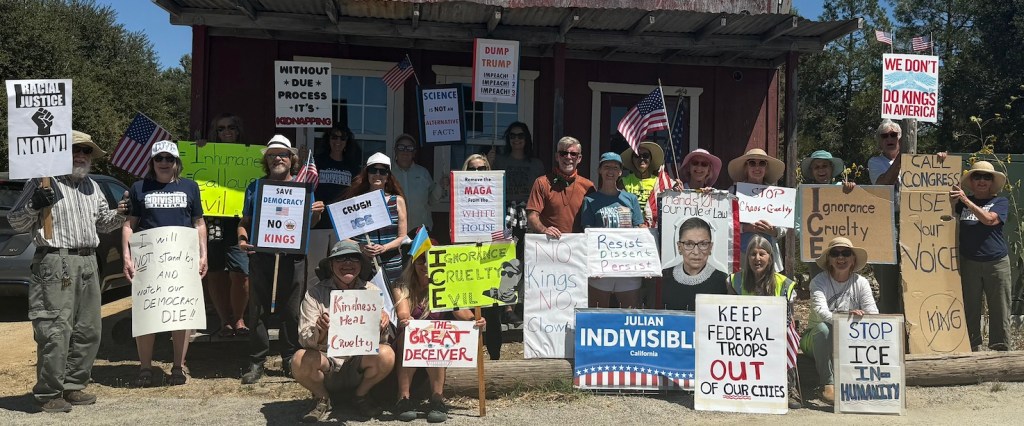
Every Sunday outside the local pie shop in Wynola, members of my Julian-Wynola, community gather, signs in hand, whistles around our necks, hats against the sun or the rain or the wind. We gather in a new kind of ritual born out of an alchemy of desperation and disbelief. It’s our way of staying sane in an unrecognizable, off-the-rails world. The national and international news darkens each week; it weighs so heavy on our minds, creates disturbing confusion about what our country has become.. Frustration builds. Anxiety about loved ones, our military, our immigrant friends, grandchildren, and neighbors keeps us holding our collective breath.

Our Sunday ritual becomes my confession, my cleansing, my come-together with like-minded people. We have grown to be friends through resistance, friends in Good Trouble as we stand along the roadway, signs in hand.

So regularly there, we’ve even become pals with the frog in the bushes next to the Mom’s Pies sign. Each week we watch for the emerging daffodils and hyacinths and tread carefully around the growing buds. We have our favorite spots to stand, even sometimes bring bubbles and music.

We put safety measures in place: stand behind the chalk line, all on one side, not both, a peace-keeper in a bright lime-green vest.

As each person arrives, we read one another’s new signs and compliment the owner for her/his cleverness or compassion. We talk about the weather, about who is sick and who is better, about recent travels. Most of all we share our anguish, our anger and horror at what appears each night on news programs of different kinds.

Most of us cut our emerging wisdom teeth on demonstrations against the Viet Nam War, the tear gas flying, the four dead in Ohio. We supported bus boycotts and marches in Selma. We remark how sad it is that we are still called to action. Or maybe, we muse, that this is just the way it is in a democracy—and everyone chimes in—“if we can keep it.”

Many of us are getting a little long-in-the-tooth and would rather be home watching The Pitt or re-runs of Ted Lasso while drinking a mug of ice-cold Nickel brew. But here we are, gathered, a Sunday ritual.

As we stand, we often get a little giddy. We count the honks and cheers from those in the cars that fly by, ponder the breaking of our stereotypes—motorcyclists who shout they love us, huge trucks with desert toys giving us a beep beep in solidarity.

We have stood in wind, in freezing rain, in sweltering sun, in gorgeous spring weather. One woman brings her walker. We help her to a folding chair and she proudly waves her Ice Out sign. Another person brings her old golden Labrador who sits patiently at his owner’s feet and rolls his eyes at all our cheers and silliness.

Sometimes there are grandchildren; we high-five them and tell them they are learning what “democracy looks like.” More eye rolling, more high-fives.

I admit we’ve done the hokey pokey and turned ourselves around.

 Yesterday we shouted, “And it’s 1-2-3-4, What are we fighting for? Don’t ask me, I don’t give a damn! Next stop is now IRAN.”

We count how many stand with us and rejoice if the crowd is bigger than the last. We miss people who can’t be there and are thrilled when someone new comes to join. We buy drinks at Mom’s, take trips to the pie shop bathroom when we have to. We are grateful to the owner for suggesting we gather there.

If only that woman in the red Porsche knew when she flipped me off with her black-gloved hand that we all giggled, made jokes about how her finger must be broken.

 But actually, what is she against? Us? Standing in a line with signs? More importantly what does she stand for? Is that black-gloved, red Porsche woman really happy with what our country has become? How’s the price of gas when you fill that thing?

 Or is she getting her news from some conspiracy theorist cashing in on Likes on Facebook?

And then our hour is up. I blow my whistle. I am the self-appointed ender of our session. We collect our signs, flags, and water bottles, all gather at the nearby shed—cars and trucks still honking in support—and take the weekly picture of our Julian Warriors.

We chat, pick up trash, and say goodbye. Often we are loathe to leave, the camaraderie is so intoxicating.

I collect donations from our group for the Julian food boxes each week. This group is so generous, I think we are feeding and clothing half our small mountain town.

Most notably, we are happier than when we arrived, so much more hopeful. Hopeful because in this world, there are people who choose to stand out in front of Mom’s Pie Shop every Sunday in Wynola to let the world know just how horrified, embarrassed, crazed, furious and incensed we are about our country’s actions, wars, treatment of our people, about what has become of the things we have always held so dear.

It is those faces along the roadside that I try to think of when I feel bleak. The honks, the waves, the thumbs up, the children in the back seats taking our picture. I know, because we have to, we will keep at it every week until things change, or sadly, until we are forced to stop or die.
Grandpa’s Slides

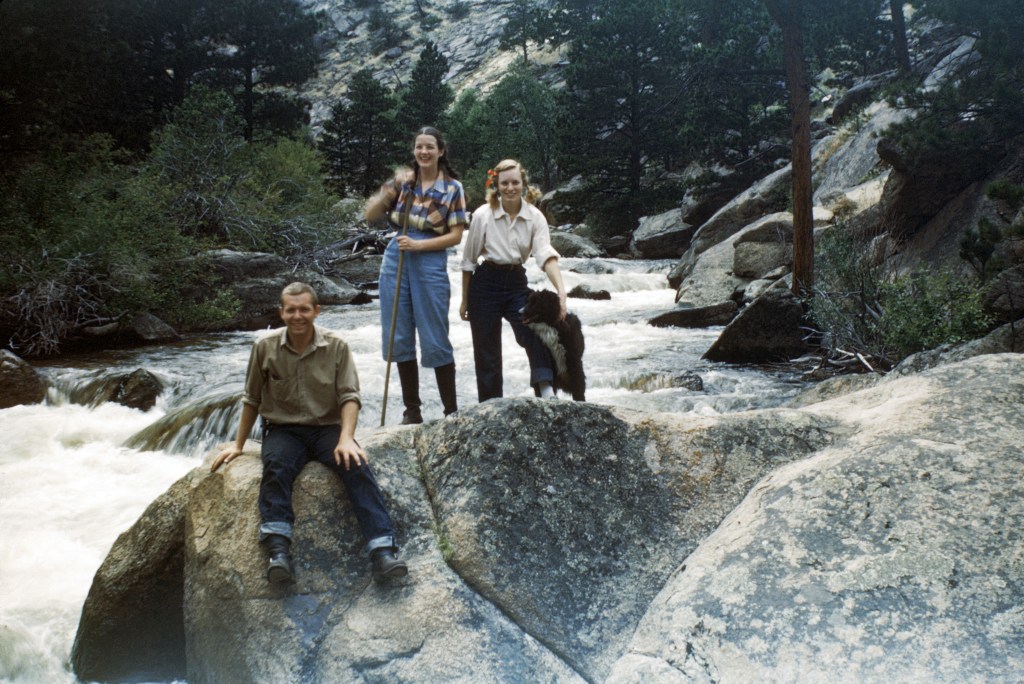
Grandpa’s Slides-Phil and Milly Danielson, Marjorie Kowlaksi with Findley.

I went through them all, as I told my cousin I would. My mission, to rid all of us of the burden of Grandpa’s slides. There were hundreds and hundreds of them and I sat, with a portable viewer, and looked at every single one. You can’t go through all those slides without a comment or a thought, or a laugh, or confusion. You can’t review them all without tears or regrets, a plethora.

 As I clicked each one into the light, I felt a rush of time like the current of water surging over  the boulders of the Frying Pan River.

There were moments at Thanksgiving tables, forced smiles, faces giving away hidden irritations. Pictures of our mothers, in different stages of pregnancy with us, with siblings, with cousins.

 Since this chore, my dreams have become old movie frames in vivid Kodachrome. Reliving my life before I was born and after and reliving those of people I knew so well, most now gone.

Slides of Grandpa Ralph with fish, hundreds of them . . . I mean hundreds of slides and hundreds of fish.  Grandma Luverne among the flowers, every type. Flowers in Hawaii, in Oaxaca, in Sweden, in Maine, in the Colorado Rockies.

Dan and Luke and  Stephen and David, and Ken, fly rods in hand, hovering over a good spot for trout. Girls didn’t fish apparently, no fishing photos of me or my sister.

Horses, long gone now, pack mules and donkeys. Grandpa took pictures of animals of any type, trained monkeys in embarrassing outfits, dancing; young  cows in feed lots ready for slaughter as veal, muddy pigs in disgusting styes, big horn sheep, mountain goats, elk, and deer.

There was an alligator in a wrestling match with some poor fool. Dogs, plenty of dogs: border collies, Labradors and shepherds. Old dogs, young dogs, stray dogs and pampered ones.

Grandpa  took pictures of every mountain he ever saw. Mountains rising on multiple continents, in different countries. Rocky Mountains, in multiple views, multiple years, multiple months, multiple angles.

Slides of glaciers now gone.

His love of mountains gushed through the films.

Grandma and Grandpa had friends, many. Friends from college, work, travels, from a distance, close up.

And there were their relatives, my relatives, our relatives. Grandpa captured them in Sweden, in Iowa on the farm. He snapped them in Nebraska in front of white picket fences and in Maine, all of them squinting into the sun. Relatives in Massachusettes, in his beloved Basalt and Aspen—family from way back—people curved over from hard work. Swedish aunties who dared exchange the harsh Colorado winters for the baking sun of California. As I clicked through each glowing slide, I fell deep with the weight of all their lives. This one  now gone, that one now gone—all now gone.

Slides, more slides. Grandma and Grandpa on their travels: in foreign living rooms, at a distant church, outside old cabins in Wyoming, in Banff, in Glacier, in Alberta, in Guatemala, in Panama, Oaxaca, all over Mexico, posing in the stocks in Salem, at the Mayflower. How did I not know how much they traipsed around? I suppose they lived while we were ensconced in our growing up.

I drank wine through a wearisome series of shots in  graveyards: graves, flags on graves, Grandma in front of graves, flowers on graves. Then there were the churches—Lutheran churches, Episcopal churches, Who-Gives-a Damn- churches.

Of course, I could have predicted this grouping— trains, train tracks, train trestles, train equipment, train spikes, train smoke, if only slides could chug-chug and whistle.

There were the family events, usually fraught with tension, I could read it on the faces frozen in crafted smiles: Christenings, weddings, funerals, holidays. Each event with multiple angles, multiple groupings, multiple table settings, multiple coordinated outfits: hats, white gloves—Grandma particularly liked mauve and lilac. Pictures of family in interiors and exteriors.

The Faculty Ranch, the cabin that now rests deep in the waters of a reservoir. A vivid Kodachrome trip back to another age. All Grandpa’s colleagues at gatherings, fish fries in the columbine, aspen, on the St. Vrain before they dammed it up. Young children in  short sets frolicking in the meadows

Then there was Ridge View, Grandma’s place in Maine. 1798. It’s quaint construction, Grandma smiling among her Maine family—Clayton Weymouth and others, Colorado family that trekked across the continent to see their ancestral home:  DeWitt, Maxine, Stephen, Vince, Michael, Dan, Dave, Ken, Keith.

Holy Cow did Grandpa love trees and Lord help us the flowers! All labeled with their specific names! I envy the detailed knowledge of varied species.

Cactus! They loved cactus . . . and lizards.

My grandparents were creatures of their surroundings, their environment, they saw such beauty in the small things and held it tight in slide film.

Many, many photographs of rattlesnakes in different stages of coil, most snappped with a hoe in the picture, ready to end the poor things lives on this earth, gone now, like Grandpa himself.

It is impossible to  name everywhere that Grandpa fished, except did I know of his men’s fishing trip on Lake Mead by Hoover Dam? There may have been alcohol involved. Don’t tell Grandma

Did I know that Grandma Luverne actually laughed a lot? Or was it just for the camera?

Aunt Lucy did not smile, ever. Grandpa clowned around whenever he could, even in Grandma’s dresses or with goofy hats. Aunt Vivian lingered in the back with a snarl. Mr. Jones and Mr. Burdette, who “married in” were saints, Uncle Clarence, a bear of a man. Missing always, Uncle Myron who was hidden away somewhere in shame. What photos of him existed, long gone.

I have now seen every float of the Rose Bowl Parade of some year when the University of Colorado  went to the Rose Bowl. And every float for CU Homecoming for how many years?

His slides wrapped me in a familiar blanket, in his basement, lights off, the glittery screen and the smell . . . what was that smell? Dust burning on the projector? Or the future lighting incense for us all?

As I went through hour after hour, day after day, I made a little pile for each of us, special slides that I hoped someone would want for whatever reason soon to be transformed into the digital technology of our time, technology Grandpa Ralph never lived to see, his life cut short while fly fishing in his favorite stream.

The “to keep” piles grew slightly, but the piles of the rejected grew into mountains like the peaks of the Colorado Rockies. After many deep breaths, a tear or two,  I took Grandpa’s hundreds and hundreds of slides, all neatly captioned and categorized by his very hands, the letters getting more spidery through the years, the slides that showed the heart and soul of his life and those of his generation, slides of things now lost and gone, the slides he snapped and developed and organized and labeled and  I took them and threw them in the trash.

I hope to be forgiven.

My Picture in the News!

https://www.thebulwark.com/p/ten-years-of-trump-with-a-bit-of-light-ahead-no-kings-resistance-military-iran-israel (Photo from The Bulwark William Kristol, Andrew Egger, Will Selber, and Jim Swift Jun 16, 2025)

Since November 2024 …I descended into hopeless despair—negative, alone, bothered, burned, depressed, stuck, furious, cynical, listless, suffering from malaise. I banned the news in any form, left for Canada—a frozen hide-e-hole full of generous people who patted us on the head and said, “We are so sorry.” It didn’t help.

On our return, I buried myself in Swedish Death Cleaning, writing about death, scribbling angst in notebooks, scrubbing out the dreary washing machine. I attended boring, useless meetings with friends suffering the same as I. No spark, no hope to fix it. I assembled three enormous jigsaw puzzles. I plugged my ears when others brought up my banned topics, read only ancient literature about far-off lands and books about fictitious detectives with chips on their shoulders.

Nothing, nothing could alleviate this, I thought. Impossible to change it, we were doomed, my grandchildren were unwitting victims of a devil. The workman tnext door shouted, “Es un demonio! Es el diablo! Que vamos a hacer?” I told him that I had no idea what to do, that perhaps we are destined for ruin and should just accept it.

But just the other day—I sensed a glimmer of a long-dormant sensation—a childish twinge of excitement. Before, I’d felt worried maybe, apprehensive, yes, but excited—not in the least. Yet here I was, actually bursting.

Why? I am embarrassed to admit…

In a rash moment, when no one else did, I volunteered to help carry the banner that led the  No King’s demonstration. Me, way to long in the tooth, carrying the banner, right in front!

How ridiculous, I thought, I’ll probably be the one who is blown to bits!

 Of course I’ll fall and take everyone down with me

I’ll be too slow and the younger banner bearers will get annoyed!

I fervently regretted it the moment I volunteered. But . . .

We arrived early at the march’s launching point so we could set up and be ready promptly. My companions went off to various activities. At the stage, as the program of speakers started I walked around in my volunteer vest feeling important, answering questions. I even officially blocked the men’s room so the women’s line would be eased. Nothing like a vest and no authority to make a person heady with power..

I thought maybe a few thousand die-hards would show up, the old guard—all of us who got tear gassed in the 60’s—with our gray hair, walkers, and our new hips.

I looked up and stood in stunned awe. The arriving crowd! Thousands and thousands of people headed my way down into Waterfront Park. They were young, old, brown, black, white, gray-haired, bald, blonde, and tattooed. They had on funny costumes, t-shirts that expressed their views. Angry, hilarious, artistic and slapped-together signs. Hundreds, thousands—Hand-Maid’s Tale women, monarch butterflies—the only monarch’s allowed—polite signs in Spanish, rude signs in Spanish. There were Pride banners, and signs that cried “No to Kings but Yes to Queens!”   60,000 plus of them.

And there I arrived in the very front. Sage smoke drifted over me as the Kumeyaay people did their prayers for our march. I felt joy, a rush of it, a shower of joy, a gall darned-rainbow-colored wash of happiness like I haven’t felt in months. We yelled, chanted, wiggled the banner; we clapped, laughed, cheered and danced.

And this a lesson I need to learn and relearn and remind myself of the rest of my life . . . that joy and the best of us are always just around the corner when you least expect it.

Loneliness Stalking

When Loneliness Comes Stalking

It happens at odd times, unexpected, vaporous, a loneliness combined with longing. A stabbing, hollow loneliness, a perpetual one.

All those babies, I miss them everyone, miscarriages, only a few weeks, but real nonetheless. They never got to see the light of day, nor feel the thump of a heartbeat.

But the worst is my loneliness for a baby boy named Joseph, a perfect child, his name came to me after he perished and I held him in my arms. That was after I pushed him out too early. A boy whose life was sacrificed to save my own.

He is a secret I’ve kept, or at least only whispered about. But now the need is great for the world to  know about the loneliness that stalks me, many women, the knowledge that I could have been . . . would have been . . . one of those new Georgia statistics, that I live, but that meant he would die.

That choice, I don’t wish on anyone and it is not done frivolously, only through desperate moments of terror, pain, tears, screams, confusion, dread and no escape. Worst of all that moment, that decision never dissolves or fades, no matter how it ends. The loneliness stalks even when you least expect it, when you are suddenly feeling happiness, or hope, or joy, that’s when the loneliness comes in stealth and can surround and choke me until I am robed in the cloth of grief and yearning and loneliness for that little Joseph whose hand I held, who I apologized to, who I apologize to every day when loneliness comes stalking.

And why loneliness? Because a decision like that was made by me, I had to make the call, alone, in my fright, alone and lonely, looking for anyone, anything besides me to blame.

Yet I will always be grateful for my few moments with my baby boy, and forever grateful that the choice was mine with the compassionate honesty of a trusted physician and not a stranger in his leather government chair passing his draconian judgement from afar.